
Why Midsize Companies Plateau at $20M–$50M (and How to Break Through)
The GAP
Short answer: Most companies stall between $20M and $50M because the things that got them there stop working at the next level: a founder who makes every decision, a sales engine built on relationships, one dominant channel or customer, operations held together by heroics, and no single roadmap that connects daily work to company value. Breaking through means replacing each of those with a system, not working harder.
If your revenue has been flat for two or three years while everyone is busier than ever, you’re not alone. This plateau is one of the most common patterns we see in manufacturers and e-commerce brands that make their own products. Here are the five ceilings, and how to tell which one is yours.
Ceiling 1: Is the founder the bottleneck?
Up to about $20M, a strong founder can be the company’s competitive advantage: closing deals, solving production problems, and approving every price. Beyond that, the same habit caps growth. Decisions queue up, good managers leave because they can’t own anything, and the company can only grow as fast as one person’s calendar.
Signs: You approve most quotes or hires. Your team waits for your answer. Vacations are working vacations.
Breakthrough: Build a second layer of leaders with clear ownership, KPIs, and a weekly accountability rhythm. Your job moves from doing the work to designing the system.
Ceiling 2: Does growth depend on relationships instead of a sales engine?
Early growth often comes from the founder’s network, a few great reps, or one lucky channel. It isn’t repeatable. At $20M+ you need a sales engine: defined target segments, a pipeline you can measure, documented messaging, and a way to onboard new sellers or channels without starting from zero.
For maker e-commerce brands, the equivalent is relying on one paid channel or one marketplace algorithm instead of a balanced acquisition mix across DTC, Amazon, wholesale, and retention.
Breakthrough: Write down your best customer profile, build a stage-based pipeline, and track conversion and cycle time weekly.
Ceiling 3: Are you over-concentrated in one customer or channel?
A big retailer, an OEM, or Amazon may have fueled your growth, and now it controls your margins and your calendar. Concentration also slashes what a buyer or lender will pay for your company.
Breakthrough: Set a concentration ceiling and build new revenue streams deliberately. Manufacturers can add direct or e-commerce channels. E-commerce brands can add wholesale, retail, or private-label production using their own capacity.
Ceiling 4: Have operations outgrown the systems?
At $10M, tribal knowledge and a great plant manager carry the day. At $40M, the same approach produces late shipments, inventory surprises, and margin leakage nobody can explain. Many plateaued companies are actually growing revenue and losing it in operations.
Breakthrough: Choose five to seven operating KPIs (on-time delivery, OEE, scrap, inventory turns, gross margin by channel), review them weekly, and document the processes that matter most. Look outside your industry for “next practices” your competitors haven’t adopted.
Ceiling 5: Is there a roadmap tied to enterprise value?
This is the ceiling under all the others. Most stalled companies have plenty of strategy: a budget, a few initiatives, maybe an offsite deck. What they lack is one roadmap tied to one goal, with annual targets broken into quarterly milestones and weekly actions, reviewed relentlessly.
Without that, priorities fragment. Sales chases revenue, operations chases efficiency, finance chases cash, and nobody chases the thing that ultimately matters to owners: enterprise value.
Breakthrough: Set a target enterprise value and a date. Identify the three to five levers that get you there. Build a Living Enterprise Value Roadmap (LEVR) and review progress weekly. This is the core of The GAP’s Enterprise Value Operating System (EVOS).
How do you know which ceiling you’ve hit?
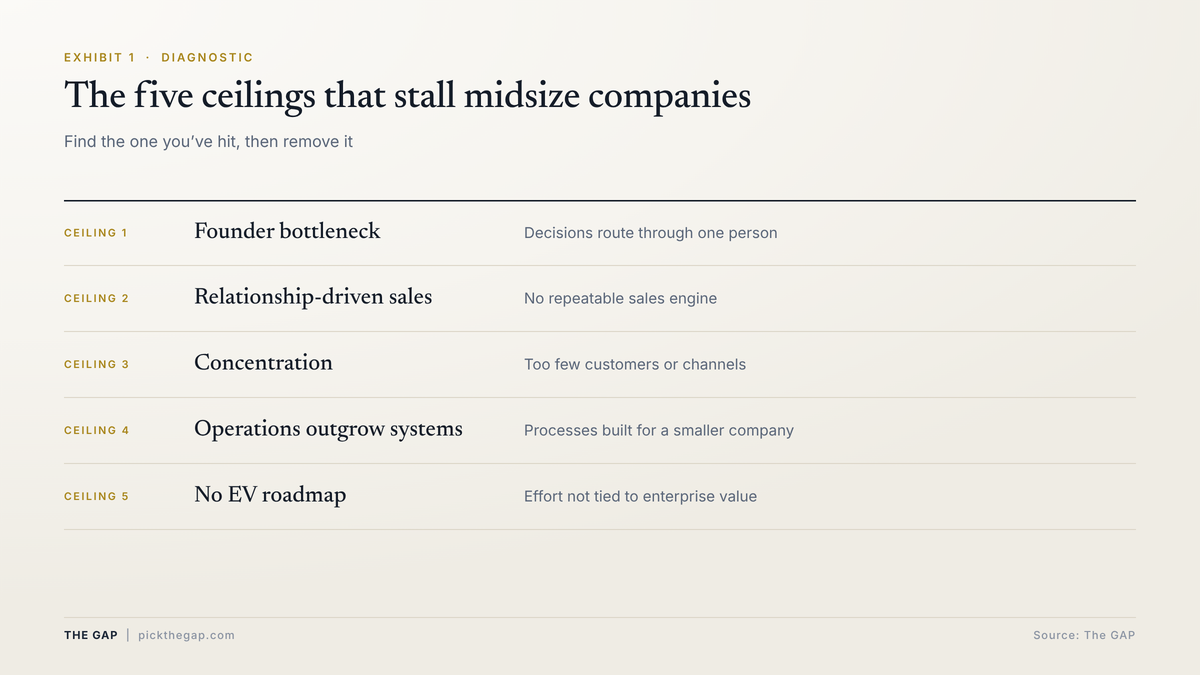
Most companies have hit two or three at once. A quick diagnostic:
| Question | If “yes,” likely ceiling |
| Do most important decisions still need the owner? | 1 – Founder bottleneck |
| Would sales drop sharply if one or two people left? | 2 – No sales engine |
| Is any customer or channel more than 25% of revenue? | 3 – Concentration |
| Do you discover margin problems after the month closes? | 4 – Operations |
| Can your team name the company’s 3-year value goal? (If “no”) | 5 – No EV roadmap |
Why doesn’t hiring a consultant or joining a peer group fix it?
They can help, but they often miss one of two things. Consultants deliver a recommendation, and implementation is left to the same overloaded team. Peer groups offer perspective but no accountability to a specific value goal. Operating frameworks such as EOS add discipline, but they aren’t designed around enterprise value, capital, or M&A.
What breaks the plateau is the combination: a roadmap tied to value, weekly accountability from someone who has scaled a company past this point, and access to the capital, talent, and deal partners the roadmap will eventually require.
What does breaking through look like?
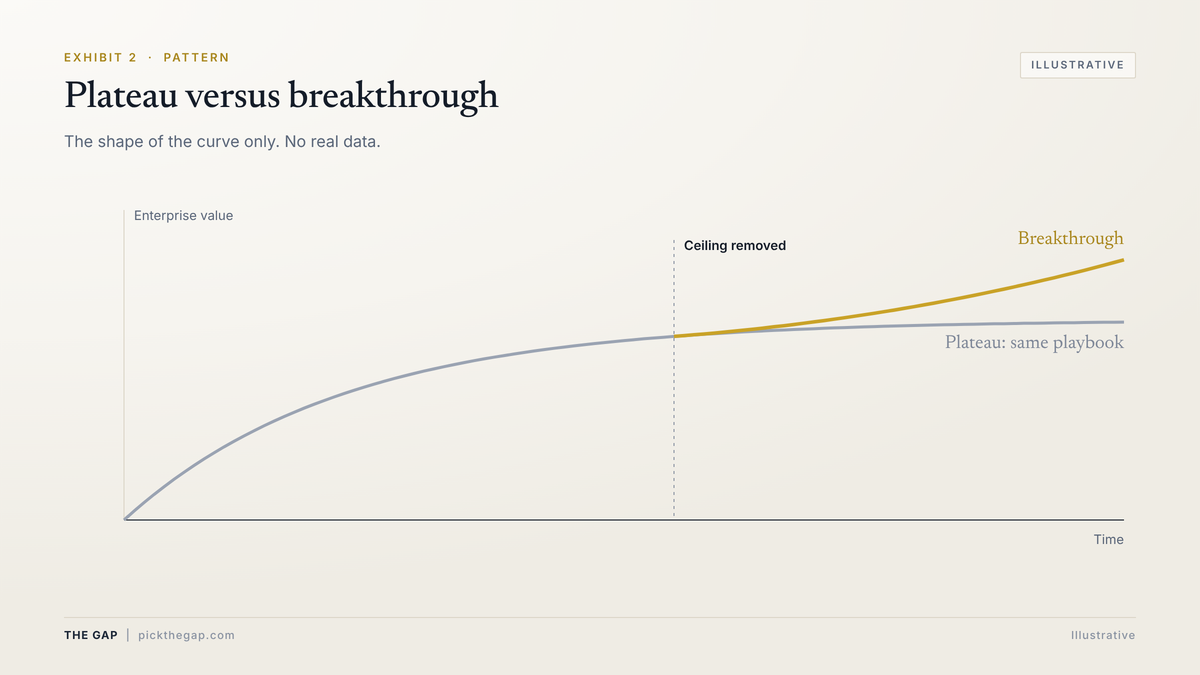
Companies that get past the plateau usually show the same pattern within 12–24 months:
- The owner spends most of their time on strategy, capital, and key relationships, not daily operations
- A leadership team owns clear KPIs and meets weekly against the roadmap
- No single customer or channel can sink the year
- Margins are explainable by product and channel, and are improving
- The company has a credible growth path, often including an acquisition, that a buyer or lender can underwrite
That’s also exactly what raises the multiple a buyer would pay.
Frequently asked questions
Why do so many companies stall around $20M in revenue? Because founder-led management, relationship-based sales, and informal operations stop scaling at that size. The company needs systems and a second layer of leaders.
Is a revenue plateau always bad? Not if profit and enterprise value are rising. A plateau becomes a problem when revenue, margins, and valuation are all stuck.
How long does it take to break a plateau? Most companies see measurable movement within two to four quarters once a roadmap and accountability cadence are in place. Bigger structural shifts take 18–36 months.
Should I focus on revenue or profit to get unstuck? Focus on enterprise value. That forces the right trade-offs between revenue quality, margins, and risk.
Do these ceilings apply to e-commerce brands that manufacture their own products? Yes, and maker brands have an extra advantage: owned production can open new channels (wholesale, private label, contract runs) that outsourced brands can’t access.
Find your ceiling
Take the See What to Fix to see which levers are holding your company back. You’ll get your score plus your top three levers in about five minutes. If you’re a $10M–$125M manufacturer or maker brand, the See What to Fix shows whether The GAP can help.
One action you can take today, every morning: See What to Fix.