
What Is Enterprise Value (and Why Revenue Isn’t It)
The GAP
Short answer: Enterprise value (EV) is what a knowledgeable buyer would pay for your entire operating business: its equity plus its debt, minus its cash. For a privately held company it’s usually estimated as normalized EBITDA × a market multiple. Revenue feeds EV, but it doesn’t decide it. Two $40M companies can be worth wildly different amounts because of profit quality, risk, and how dependent the business is on its owner.
If you own a $10M–$125M manufacturer or an e-commerce brand that makes its own products, EV is the scoreboard that matters most, whether you plan to sell, raise capital, bring in a partner, or hand the business to the next generation. Most owners don’t track it, though. They track revenue.
How is enterprise value calculated for a private company?
The textbook formula is:
Enterprise Value = Equity Value + Debt − Cash
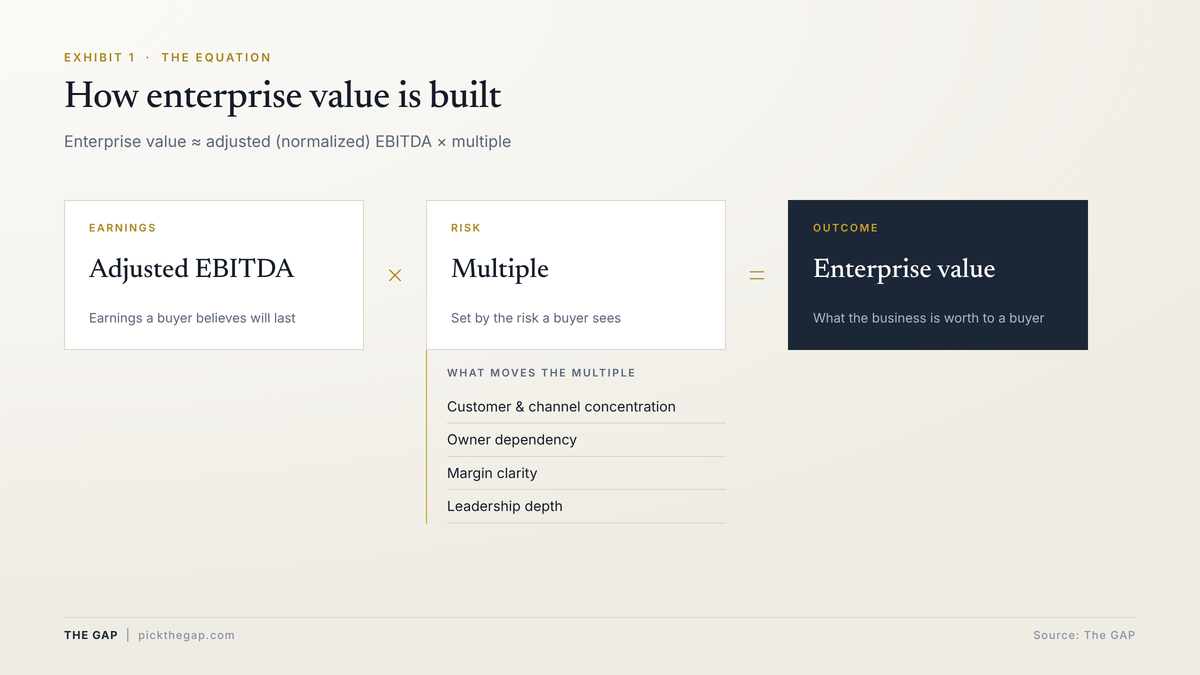
In practice, buyers, lenders, and private equity firms value private companies the other way around, starting from earnings:
Enterprise Value ≈ Adjusted (normalized) EBITDA × Multiple
- Adjusted EBITDA is earnings before interest, taxes, depreciation, and amortization, “normalized” to strip out one-time costs, above-market owner pay, personal expenses, and other noise.
- The multiple reflects how much a buyer trusts those earnings to continue and grow. It moves with industry, size, growth rate, customer concentration, margin stability, and management depth.
So you have two levers: grow the earnings and raise the multiple. Most owners only pull the first one.
Why doesn’t revenue growth automatically raise enterprise value?
Because revenue is an input, not an outcome. Revenue growth that comes with any of these can leave EV flat or even push it down:
- Margin erosion. You bought the growth with discounts, ad spend, or expedited freight.
- Concentration. One retailer, one Amazon listing, or one OEM customer now makes up 40% of sales.
- Founder dependency. Every big deal, price change, and hire still goes through you.
- Working-capital drag. Inventory and receivables grew faster than cash.
- Unrepeatable sources. A viral product or a one-time contract that a buyer will discount.
That’s why we say: revenue up 30% at the same multiple is just more work. Real EV growth comes from earnings a buyer believes will last.
What drives the multiple for manufacturers and maker brands?
Buyers pay higher multiples for lower risk and visible growth. For companies that make what they sell, the drivers we see most often are:
| Driver | Lowers the multiple | Raises the multiple |
| Customer mix | A top customer above 20–25% of revenue | Diversified across channels and accounts |
| Revenue quality | Project-based, one-off orders | Recurring, contracted, subscription, or replenishment |
| Margin story | Margins nobody can explain by SKU | Clear unit economics by product and channel |
| Leadership | Owner is the bottleneck | A second layer of leaders runs the business day to day |
| Operations | Undocumented, tribal knowledge | Repeatable processes and KPIs |
| Production | Capacity sitting idle, or maxed out | Spare capacity with a plan to fill it profitably |
| Growth path | “More of the same” | Credible roadmap: new channels, products, acquisitions |
Owned production is an under-used advantage for e-commerce brands in particular. A brand that controls its manufacturing controls quality, speed, and margin, and can show a buyer a moat that an outsourced competitor can’t.
What’s the difference between enterprise value and equity value?

Equity value is what the owners actually walk away with. Start with enterprise value, subtract debt, and add excess cash. If your business is worth $30M in EV and carries $8M in debt, the equity is worth about $22M before deal costs and taxes. That’s why paying down debt or cleaning up the balance sheet can matter as much as growing EBITDA when you get close to a transaction.
How do you increase enterprise value in practice?
You treat EV as the goal the whole company runs toward, not as a number you look up the year you want to sell. At The GAP we call this the Enterprise Value Operating System (EVOS). Roughly, it works like this:
- Baseline it. Estimate today’s normalized EBITDA and a realistic multiple range. Be honest about what a buyer would discount.
- Pick the levers. Find the three to five changes that would move earnings or the multiple most: pricing, channel mix, concentration, leadership depth, capacity use, or an acquisition.
- Build a living roadmap. We call it the Living Enterprise Value Roadmap (LEVR): annual goals broken into quarterly milestones, monthly targets, and weekly actions, each tied to the EV goal.
- Install accountability. A weekly cadence with someone who has scaled a company before and will hold the leadership team to the roadmap.
- Get access to resources. Capital partners, M&A advisors, and executive talent at the moment the roadmap calls for them, not after a crisis.
One operator lesson we keep coming back to: don’t just benchmark your competitors. Copying your own industry’s best practices makes you look like everyone else, and buyers pay a premium for difference. The bigger edge often comes from “next practices,” methods proven in another industry that nobody in yours has tried yet.
When should an owner start focusing on enterprise value?
Two to three years before you need it, at the latest. Buyers and lenders look at trailing performance, usually the last 12–36 months. Changes like reducing customer concentration, building a leadership team, or proving out a new channel take time to show up in the numbers. Owners who start the year they want to sell usually settle for the multiple they already have.
Even if you never plan to sell, EV is the best single measure of whether the company is getting stronger. It also widens your options: refinancing, an ESOP, a strategic partner, a family office, or becoming the acquirer yourself.
Frequently asked questions
Is enterprise value the same as what my company would sell for? Close, but not exactly. EV is the value of the operating business. The sale price to you depends on debt, cash, working-capital targets, deal structure (earnouts, rollover), and taxes.
What EBITDA multiple will my company get? It depends on industry, size, growth, and risk. Smaller private companies typically trade at lower multiples than larger ones, and the same company can see a very different multiple after it fixes concentration and founder dependency. A credible estimate starts with normalized EBITDA and a review of risk factors.
Does revenue matter at all? Yes. Size matters because larger companies often earn higher multiples. But profitable, repeatable, diversified revenue matters far more than the top-line number.
Can enterprise value grow if profits are flat? Yes, if the multiple rises. Reducing risk (concentration, owner dependency, undocumented operations) can raise what a buyer will pay for the same earnings.
How often should I estimate my enterprise value? At least once a year, and every quarter if you’re actively working a roadmap. What gets measured gets managed.
Next step: see what a buyer would see
Fix Check
Use this if you might sell or bring in investors in the next few years. A few quick questions show the top things a buyer would ding you for, like a business that leans too hard on you, a few customers making up most of your sales, or messy books. You’ll know what to fix first, before it cuts your price.
EVO Checklist
Use this if you want to know whether you have a system for growing value every week. Six questions, about two minutes. It checks for a value roadmap, a clear owner for each fix, a baseline number and a regular review.
The Fix Check finds what’s hurting your value today. The EVO Checklist tells you if you have the habits to keep raising it.