
How to Increase the Valuation of a Manufacturing Company: 9 Levers
The GAP
Short answer: You raise a manufacturer’s valuation in two ways: grow normalized EBITDA and earn a higher multiple by lowering the risk a buyer sees. The nine levers below cover both. They range from pricing discipline and capacity use to customer diversification, leadership depth, and add-on acquisitions. Most $10M–$125M manufacturers have at least three of them untouched.
Valuation isn’t something that happens to you at exit. It’s the result of decisions you make every quarter. Here are the levers we see move the needle most for privately held manufacturers and brands that make their own products.
1. How does pricing affect a manufacturer’s valuation?
Pricing is the fastest EBITDA lever you have. A 2–3% price increase on stable volume can drop almost straight to the bottom line. Many owner-led manufacturers haven’t repriced in years, or they price on cost-plus without knowing true cost by SKU.
Do this: Rank your top 20 SKUs or customers by contribution margin. Reprice the bottom quartile, or drop it.
2. Is idle capacity hurting or helping valuation?
Both, depending on what you do with it. Unused capacity is a cost you’ve already paid for, and it’s also a growth engine waiting to be switched on. Operators we work with ask one question first: what percentage of capacity is each line actually running at?
Do this: If lines are running well below capacity, test white-label production for others in your category, contract manufacturing runs, or a direct-to-consumer line that uses the same equipment.
3. Why does customer concentration lower the multiple?
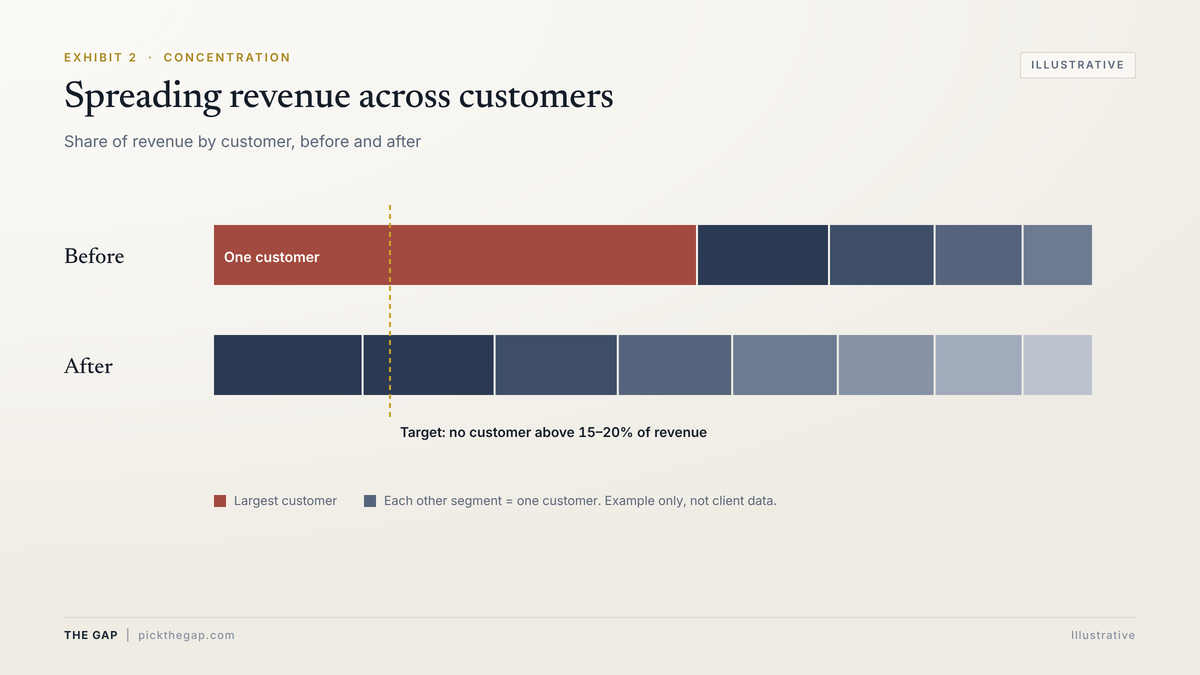
If one customer, retailer, or OEM is a quarter of your revenue, a buyer is pricing in the day that customer leaves. Concentration is one of the most common reasons good manufacturers get discounted multiples.
Do this: Set a target, for example no customer above 15–20%, and build a 24-month plan to get there through new accounts, new channels, or e-commerce.
4. How do you make revenue more “recurring” in manufacturing?
Buyers pay more for predictable revenue. Manufacturers can create it through supply agreements, blanket POs, replenishment programs, consumables tied to installed equipment, service contracts, and subscriptions for DTC products.
Do this: Identify the customers who already reorder on a rhythm and offer them a contracted program in exchange for priority capacity or pricing stability.
5. Can you explain your margins by product and channel?
“We make about 30%” won’t survive diligence. Buyers want to see gross margin by SKU, customer, and channel, plus the reasons it moves. Clear unit economics raise confidence, and confidence raises the multiple.
Do this: Build a simple monthly margin bridge that shows price, volume, mix, materials, labor, and freight.
6. Does owner dependency really reduce valuation?
Yes, and often by more than owners expect. If the founder holds the key relationships, approves every quote, and is the only one who understands the plant, a buyer is really buying a job. A second layer of leaders, such as a GM or COO, a sales leader, and a controller who runs a monthly close, can change the multiple itself.
Do this: List every decision that needs you this month. Delegate the top five, with a KPI and a weekly check-in.
7. How do operations and documentation affect value?
Documented processes, safety and quality systems, preventive maintenance, and a handful of tracked KPIs (OEE, on-time delivery, scrap, inventory turns) tell a buyer the plant runs without heroics.
Do this: Pick five operating KPIs, put them on one page, and review them weekly with the leadership team.
8. Should you look outside your industry for improvement ideas?

Yes. Benchmarking competitors makes you just like them. The real edge often comes from “next practices”: methods proven in a different industry that nobody in yours has tried yet. An assembly-line practice from automotive can transform an HVAC line. A replenishment model from consumer packaged goods can steady an industrial parts business.
Do this: Once a quarter, have your leadership team study one company outside your industry and bring back one practice to pilot.
9. When does an add-on acquisition make sense?
Once your operating platform is solid, buying a competitor, a supplier, or a complementary product line can grow EBITDA faster than organic growth. It can also move you into a larger size bracket where multiples tend to be higher. The owner who becomes the platform, buying a competitor instead of selling to one, often creates the most value.
Do this: Make a list of 10 companies you’d buy if capital weren’t the constraint. Many of their owners are thinking about exit options right now.
How do these levers fit together?
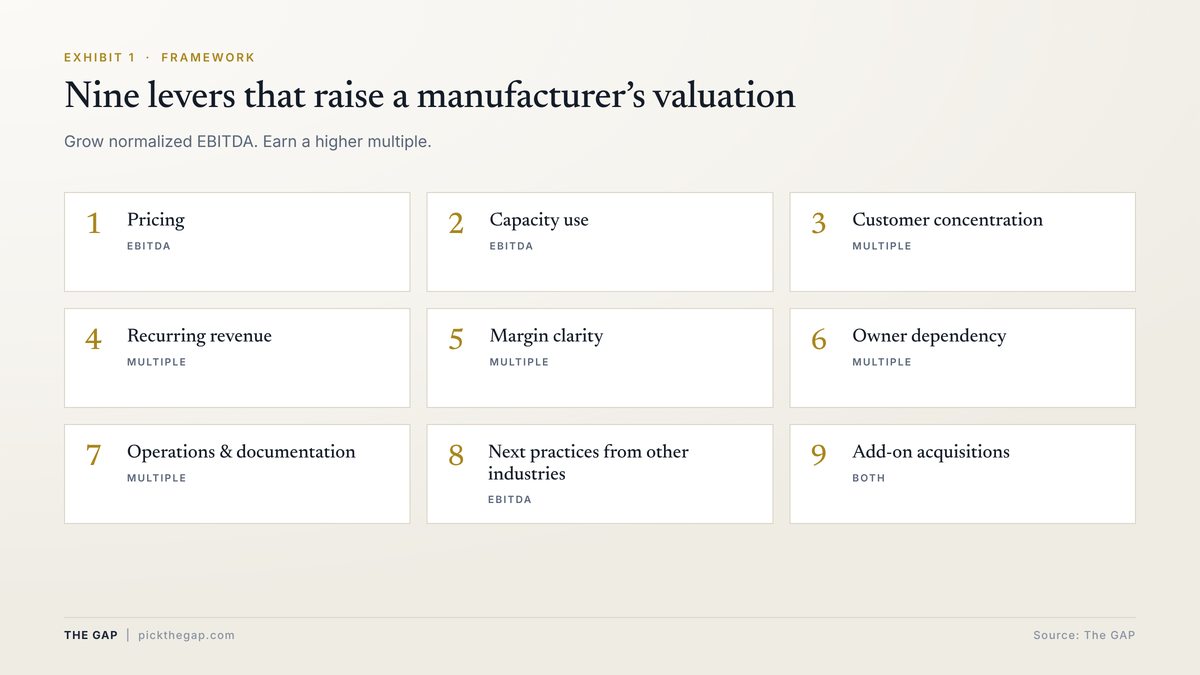
On their own, these are projects. Together, they make up a roadmap. At The GAP we tie them to one goal, a target enterprise value, through our Enterprise Value Operating System (EVOS) and a Living Enterprise Value Roadmap (LEVR) that breaks the goal into quarterly milestones and weekly actions. An embedded operator who has scaled companies to $100M+ holds the team accountable to it every week and opens doors to capital, M&A advisors, and executive talent when the roadmap calls for them.
A rough sequence for most manufacturers:
| Phase | Typical focus |
| First 90 days | Pricing, margin visibility, KPI cadence, top owner-dependent decisions |
| 3–12 months | Capacity utilization, recurring programs, leadership hires |
| 12–24 months | Customer diversification, new channels such as e-commerce, documented operations |
| 18–36 months | Add-on acquisitions, capital strategy, exit or recapitalization options |
Frequently asked questions
What is the fastest way to increase my manufacturing company’s value? Usually pricing and mix: repricing low-margin SKUs and customers. It raises EBITDA within a quarter or two without new capital.
How long does it take to meaningfully increase valuation? Earnings changes can show up within a year. Multiple improvements, from less risk and deeper leadership, usually take 18–36 months to become credible to buyers.
Do I need to sell to benefit from a higher valuation? No. Higher enterprise value improves your borrowing power, recapitalization options, ESOP value, and ability to make acquisitions.
What do private equity buyers look for in a manufacturer? Stable or growing EBITDA, diversified customers, explainable margins, a management team that runs without the owner, room to grow (capacity, channels, acquisitions), and clean financials.
What if my company is under $20M in revenue? The same levers apply. The early focus is on structure, discipline, and accountability that build the foundation for the larger levers.
See if your company is a fit
If you run a $10M–$125M manufacturer or a brand that makes its own products, take the See What to Fix. We work on a performance basis and only engage when we believe we can grow your enterprise value significantly.
Get one lever you can act on today, every morning: See What to Fix.