
Performance-Based Consulting: How It Works and When It’s Worth It

The GAP
Short answer: Performance-based consulting ties some or all of an advisor’s compensation to measurable results, such as profit improvement, revenue growth, or increased enterprise value, instead of billing only for time. Done well, it aligns the advisor with the owner: they win only when the company wins. It works best when results can be measured clearly, the advisor is involved in implementation (not just recommendations), and both sides agree on the baseline up front.
Traditional consulting has a well-known problem. You pay for the hours and the deck whether or not anything changes. For owners of midsize manufacturers and e-commerce brands that make their own products, that’s a hard trade. Performance-based models flip the risk. Here’s how they work, what to watch for, and how The GAP approaches it.
How does performance-based consulting work?
Most pay-for-results arrangements combine some of these components:
- A defined baseline. Where the business is today: revenue, EBITDA, margins, or estimated enterprise value.
- Agreed measures of success. Which results count, how they’ll be measured, and over what period.
- A compensation structure. Typically fully performance-based, or a blend of a base amount plus a performance component.
- Participation in newly created value. The strongest models reward the advisor only on value created after the engagement starts, never on what the owner already built.
- Governance. Regular reviews, transparent reporting, and a clear way to settle how results are attributed.
Why would an advisor take on that risk?
Because they’re confident in their ability to deliver, and because aligned incentives produce better outcomes. An advisor paid on results has every reason to focus on the few changes that matter most, push for implementation, and stay engaged long after a traditional project would have ended.
It also forces discipline on the advisor’s side. A performance-based firm has to be selective. It can only take engagements where it’s confident it can create significant value.
What are the risks or downsides?
Performance-based arrangements aren’t automatically better. Watch for:
- Vague metrics. “Growth” with no baseline leads to disputes. Insist on clear definitions.
- Short-termism. An advisor paid only on this year’s profit might cut investments that build long-term value. Measures tied to enterprise value reduce this risk.
- Attribution fights. Market tailwinds, price increases already in motion, or a big order landed before the engagement. Agree up front how these are treated.
- Advice without involvement. If the advisor doesn’t help implement, results depend entirely on your team’s capacity.
When is performance-based consulting worth it?
It’s usually a strong fit when:
- Your company is established (typically $10M+ in revenue) with real growth potential that isn’t being captured
- You have a plateau, fragmented priorities, or operational complexity limiting scale
- You want hands-on help and accountability, not just a report
- You care about enterprise value, because you’re planning for a sale, recapitalization, succession, or simply building a more valuable company
- You’re willing to implement: the model only works if guidance turns into action
It’s usually a poor fit for a company in crisis that needs a turnaround specialist, for one-off technical projects, or for owners who aren’t ready to change how decisions get made.
Questions to ask any performance-based advisor
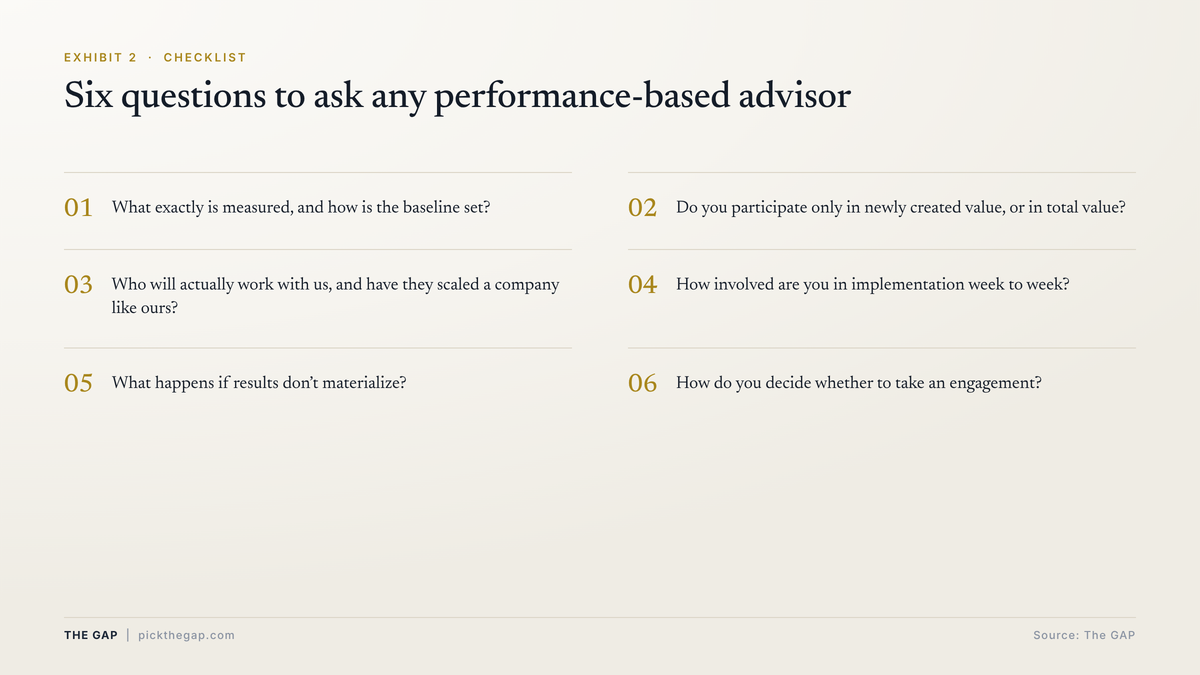
- What exactly is measured, and how is the baseline set?
- Do you participate only in newly created value, or in total value?
- Who on your team will actually work with us, and have they scaled a company like ours?
- How involved are you in implementation week to week?
- What happens if results don’t materialize?
- How do you decide whether to take an engagement?
A credible advisor will answer every one of these clearly.
How does The GAP’s performance-based model work?
The GAP isn’t a traditional consulting firm or a marketing agency. We help privately held companies, with a focus on $10M–$125M manufacturers and e-commerce brands that make their own products, systematically increase enterprise value. Here’s what’s included:
- Enterprise Value Operating System (EVOS): our framework for running the company around an enterprise value goal.
- Living Enterprise Value Roadmap (LEVR): annual, quarterly, monthly, and weekly milestones tied to that goal.
- Embedded Managing Director: weekly 1:1 advisory and accountability with an operator who has scaled relevant companies to $100M+.
- Billion Dollar Board: recurring advisory from former billion-dollar CEOs.
- Warm access to capital partners, M&A advisory, executive talent, and vetted strategic resources.
Our model is built on performance. We share only in newly created value, never in the value you’ve already built. We'll cover the details on a call. And we’re selective: before proposing anything, we learn about your business and confirm we can grow its enterprise value by a large multiple of our engagement. If we can’t, we’ll tell you. We share the specific structure on a call once we’ve both confirmed the fit.
What does a performance-based engagement look like week to week?
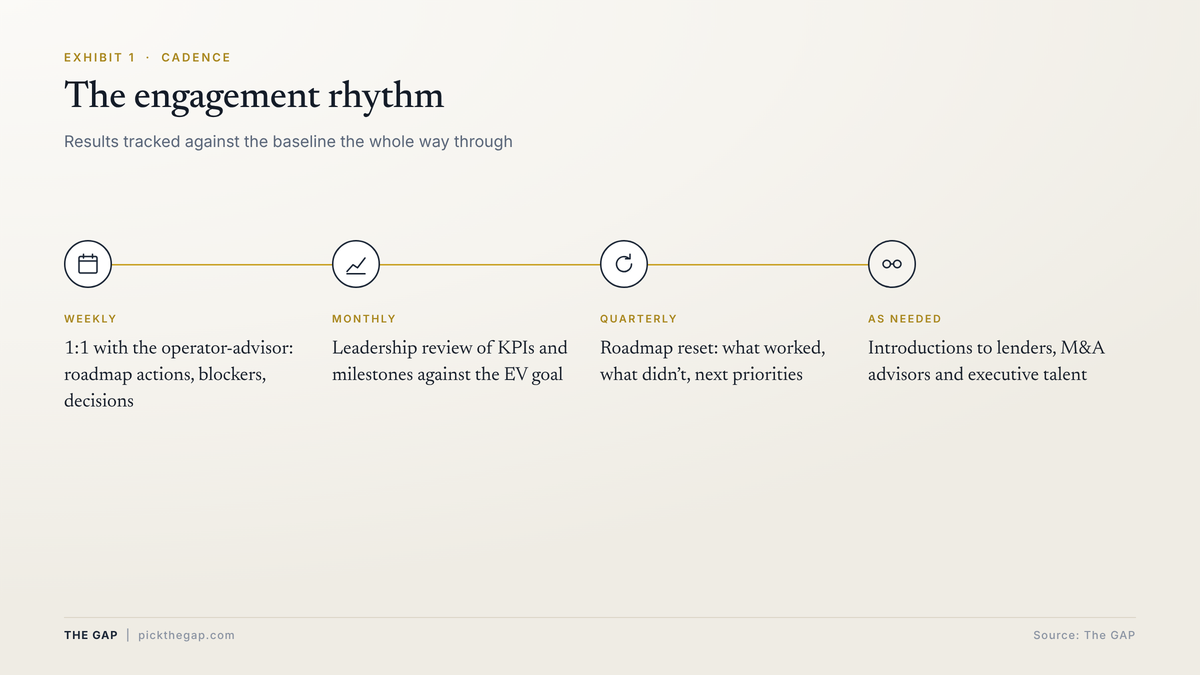
In a well-run engagement, the advisor is part of how the company operates. A typical rhythm:
- Weekly: a 1:1 between the owner and the operator-advisor to review roadmap actions, remove blockers, and make decisions.
- Monthly: a leadership review of KPIs and milestones against the enterprise value goal.
- Quarterly: a roadmap reset. What worked, what didn’t, and the next quarter’s priorities.
- As needed: introductions to lenders, M&A advisors, or executive candidates when the roadmap calls for them.
Results are tracked against the baseline the whole way through, so nobody is surprised about what has changed.
Performance-based vs. traditional consulting vs. fractional executives
| Traditional consulting | Fractional executive | Performance-based (The GAP) | |
| Paid for | Time and deliverables | Time | Results and newly created value |
| Implementation | Usually your team | Partial | Weekly accountability against a roadmap |
| Focus | A project | A function | Enterprise value across the company |
| Access to capital, M&A, talent | Rarely | Limited | Coordinated access |
| Risk to owner | High | Medium | Shared |
Frequently asked questions
Is performance-based consulting more expensive? It depends on results. Because compensation is tied to value created, the advisor earns more only when the company gains more. The structure is worked out during a qualified conversation.
What results are typically measured? Common measures include EBITDA improvement, revenue growth, cost savings, and increases in enterprise value. The best models focus on enterprise value because it captures both profit and risk.
Do performance-based advisors take equity? Models vary. Ask any advisor exactly how they participate and whether it applies only to newly created value.
How do I know if my company qualifies? Most performance-based firms are selective. At The GAP, the first step is a short Fix Check, followed by a conversation about your business.
Can a smaller company use a performance-based model? Yes. Some firms, including The GAP, offer group-based programs for companies under $20M that focus on structure, discipline, and accountability.
See if you’re a fit
Take the See What to Fix. If there’s a fit, we’ll schedule a conversation to learn about your business and walk through how our model would apply.
Not ready to talk? Get one practical enterprise value move every morning: See What to Fix.